- A tight Achilles loosens up. The tendon joins both calf muscles to the heel bone [1], so two calf stretches free it: holds of 10 to 30 seconds, about 60 seconds per muscle, at least two to three days a week [2].
- A sore Achilles gets strong again. Heel-raise loading has the physiotherapy guideline's strong-evidence grade [3]. Give it at least 12 weeks of calf strengthening [4] and count progress in months.
- Pain at the heel bone? Stay on flat ground. Deep stretches and heel drops below a step can make insertional pain worse. Work from the floor [4][5].
- Know the one emergency. A sudden snap or pop at the back of the ankle, after which you cannot rise onto your toes, is a possible rupture. Get it seen the same day [6][7].
- FlexBuddy® keeps your calves long. Sit tall, foot bar under the forefoot, and stretch a tight, pain-free calf and Achilles with a pull you set by hand.
What is the Achilles tendon, and why does the calf decide how it feels?
The Achilles tendon is the cord you can pinch at the back of your ankle. It is the largest tendon in the body [8], and it passes the pull of two calf muscles to the heel bone. The gastrocnemius, the visible bulge of the calf, starts just above the knee, so it crosses both knee and ankle. The soleus lies underneath and crosses the ankle only. Their fibres merge into the one tendon [1].
Running puts four to six times body weight through that tendon [9]. When the calf muscles are short, the ankle runs out of dorsiflexion (the shin travelling forward over the foot) sooner, and the tendon is pulled taut earlier in every stride. That is a tight Achilles: common, harmless, and exactly what stretching is good at. Lengthen the calf and the tug behind your ankle eases (see our guide to tight calves).
A sore Achilles is a different job. Tendinopathy (older names: tendonitis, tendinitis) is a tendon that has become painful, stiff and often thickened, thought to follow repeated stress from a sudden rise in load [10]. You are in good company: the Dutch guideline puts a runner's lifetime risk at roughly one in two [4]. Both problems have a clear answer: a short muscle wants length, a sore tendon wants carefully dosed strength work.
Tight Achilles, tendinopathy or rupture: how do you tell them apart?
Three things get called "a bad Achilles", and each has its own fix. Find your column.
| Tight Achilles | Achilles tendinopathy | Achilles rupture | |
|---|---|---|---|
| How it starts | Slowly; you cannot name the day | Gradually, often after a jump in training or a change of shoes [8][10] | In one moment: a push-off, a landing, a sudden change of direction [1][7] |
| What you feel | A pull behind the ankle at the end of a stretch or deep squat; nothing at rest | Pain and stiffness in the tendon on the first steps after rest, and during or after activity [10][8] | Sudden, severe pain, sometimes with a pop or snap you can hear [6][10] |
| Where | Along the calf and tendon | One spot: 2 to 7 cm above the heel bone (mid-portion) or within 2 cm of it (insertional) [4] | Back of the ankle, with swelling near the heel [7] |
| Rising onto your toes | Easy and painless | Possible, though it may hurt | Often impossible on that leg [7] |
| What helps | Regular calf stretching, at a wall or seated with FlexBuddy | A loading programme for at least 12 weeks [4] | Medical assessment the same day [6][10] |
The guideline's own self-check for tendinopathy: symptoms localised to the tendon, pain when you load it, pain when you pinch it, and often a thickened spot. With all four, no scan is needed [4]. With none, you are in the first column and the stretches below are yours. Pain under the heel, on the sole side, is not the Achilles; see our plantar fasciitis stretches guide.
Achilles rupture red flags: when is it urgent?
A rupture is a partial or complete tear of the tendon [1]. It typically happens in a forceful push-off, a landing from a jump or a sideways cut in sport [1][7]. The signs are:
- sudden, severe pain during an activity [6];
- a popping or snapping sound or sensation as it happens [6][10];
- swelling near the heel [7];
- being unable to stand on the toes of that leg, or to walk on it [7].
If that describes you, get help the same day. In the UK, call NHS 111 or go to A&E [6][10]; elsewhere, an urgent care or emergency department. Do not test it with a stretch or wait to see whether it settles. Treatment means at least six weeks in a boot or cast, sometimes surgery [7].
Fluoroquinolone antibiotics such as ciprofloxacin, and corticosteroid injections near the tendon, have been linked to tears [7]; mention either to your doctor.
Mid-portion or insertional tendinopathy: why does the location matter?
Find the sore spot with two fingers: it picks your exercises. Mid-portion tendinopathy sits in the body of the tendon, 2 to 7 cm above the heel bone; insertional tendinopathy is within the last 2 cm, where the tendon attaches to the bone [4]. Mid-portion is the more common form [10] and the classic runner's version [8]. Roughly a third of people with Achilles tendon pain have the insertional kind [9].
Why pain at the heel bone wants flat ground
A tendon is built to be pulled. At the heel, the Achilles is also squeezed. As the ankle bends upwards into dorsiflexion, the deep surface of the tendon is pressed against the heel bone, so the insertion takes compression on top of tension [9]. Compressive load is thought to help start and maintain tendinopathy [11]. Deep dorsiflexion is where a calf stretch ends and where a heel drop off a step bottoms out.
On the standard full-range heel-drop programme, 89% of mid-portion tendons did well, against 32% of insertional tendons [12]. In a laboratory study of sore tendons, a standing calf stretch raised pain by 2.8 points on a 0 to 10 scale compared with rest, and insertional pain reacted more to stretching than mid-portion pain [13].
So the rule for pain at the heel bone: no stretches pushed to the end of the ankle's range, no heel drops off a step [8], and exercises done from the floor until the tendon has calmed down [4]. From the floor, the same strengthening suits it well.
Should you stretch a sore Achilles? Heel raises come first
A sore Achilles responds best to load. The American physiotherapy guideline for mid-portion tendinopathy grades mechanical loading as backed by strong evidence, and lists stretching as an option for people who have also lost ankle range [3]. In the one trial that set stretching against eccentric exercise, both groups improved steadily over a year, with no significant difference between them [14]. So gentle mid-portion stretching is welcome, and heel raises are the engine. The Dutch guideline starts treatment of both types with education, load management and at least 12 weeks of progressive calf strengthening [4].
Eccentric heel drops: the Alfredson protocol
In the 1998 study that changed Achilles treatment, recreational athletes whose long-standing pain had stopped them running did 12 weeks of heavy eccentric calf training. Every one of them returned to running at their previous level, while a comparison group treated conventionally all went on to surgery [15]. Loading has been the standard ever since.
"Eccentric" means the muscle works while it lengthens: the lowering half of a heel raise. Stand on the edge of a step on the sore leg, lower the heel slowly below the step, then use the other leg to come back up. Do three sets of 15 with the knee straight and three with the knee bent, twice a day, every day, for 12 weeks: 180 repetitions a day. Discomfort is allowed as long as it is not disabling, and once the work is pain-free you add weight in a backpack, 5 kg at a time [16].
Heavy slow resistance
Prefer the gym? Heavier, slower sessions work just as well. In a randomised trial, 12 weeks of heavy slow resistance training improved pain and function as much as the Alfredson programme, the gains held at one year, and people completed more of their sessions (92% against 78%) [17]. The recipe, slow heel raises against machine weights three times a week, is in the table below [18]. A systematic review of 32 studies found little evidence that the lowering phase has to be isolated [19]. Pick the version you will keep doing.
The insertional variant: stop at floor level
For pain at the heel bone, the same Swedish group changed one thing. The lowering was done standing on flat ground, so the heel stopped at the floor and the ankle never went into dorsiflexion. It worked: 67% of patients were satisfied and back to their previous activity at four months [5]. That is why guidance now says to begin insertional exercises on a flat surface [4]. A lift of 1.3 to 2.5 cm under the heel during the raises limits dorsiflexion further [20].
| Programme | For | How | Dose | Duration |
|---|---|---|---|---|
| Alfredson eccentric heel drops [16] | Mid-portion pain | Off a step, heel lowered below step level; knee straight, then bent | 3 × 15 of each, twice a day | 12 weeks |
| Heavy slow resistance [18] | Mid-portion pain, gym access | Slow heel raises, up and down, against heavy load | 3 to 4 sets, from 15 reps down to 6 as the load rises; 3 sessions a week | 12 weeks |
| Floor-level eccentric [5] | Insertional pain | On flat ground: slow heel lowering that stops at the floor | 3 × 15, twice a day | 12 weeks |
Some discomfort while you load is normal; the working rule is to avoid moderate or severe pain and symptoms that worsen over time [20]. If nothing has changed after 6 to 12 weeks, see a physiotherapist [10].
How long does it take?
Stick with it and the results last. Twelve weeks of exercise is the minimum [4], and the physiotherapy guideline counts a successful recovery at 6 to 12 months [3]. Starting today beats waiting: little or no short-term improvement can be expected from a wait-and-see approach [4]. Five years after an exercise-only programme, 80% of patients had fully recovered [21]; five years after the Alfredson programme, patients' scores had improved a great deal [22].
When is stretching the right tool, and how do you do it safely?
Stretch the Achilles when it is tight and not sore: no morning pain, no tender or thickened spot, no pain on stairs or hopping. A meta-analysis of five randomised trials found that static calf stretching increases ankle dorsiflexion by about 2 to 3 degrees, a consistent gain [23]. You feel it as a freer stride. An "Achilles stretch" is a calf stretch, and it takes two positions because the two calf muscles cross different joints [1].
The two calf stretches
- Straight-knee wall stretch (gastrocnemius). Hands on a wall, one foot stepped back, heel on the floor, toes pointing forwards, back knee straight. Move your hips towards the wall until you feel the pull high in the calf.
- Bent-knee wall stretch (soleus). Same stance with the back foot a little closer. Bend the back knee with the heel still down until the pull drops low, towards the Achilles.
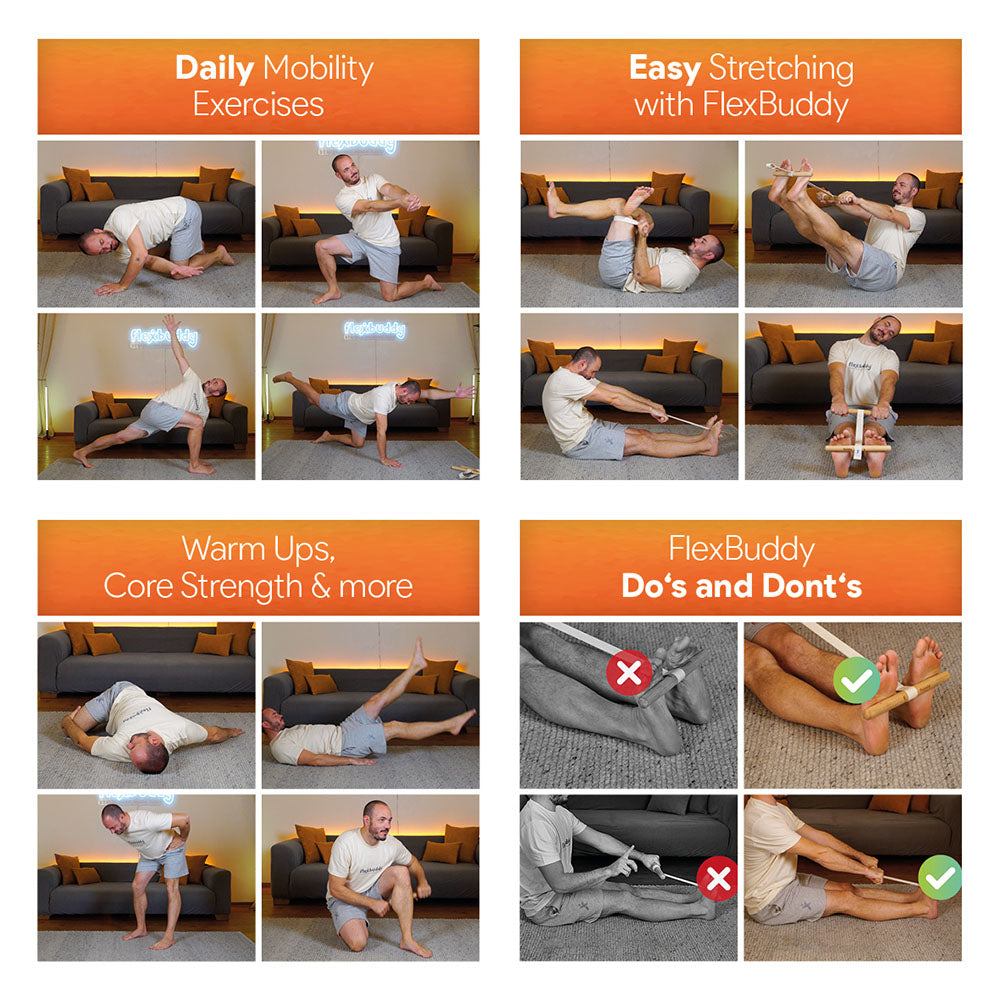
The seated version, with FlexBuddy. Sit with one leg straight, the foot bar of your FlexBuddy under the forefoot and the hand bar in both hands. Sit tall and draw the toes towards the shin until the calf pulls: knee straight for the gastrocnemius, slightly bent for the soleus. The strap carries the pull, so your back stays long, and a roll of the hand bar sets the depth exactly. Hold for ten slow breaths.
The dose comes from the American College of Sports Medicine: hold each stretch for 10 to 30 seconds (30 to 60 seconds if you are older), repeat two to four times so each muscle gets about 60 seconds in total, on at least two to three days a week, daily for the most gain. Go to a feeling of tightness or slight discomfort and no further [2]. More variations are in our guide to calf stretches; an ankle that feels blocked at the front of the joint belongs to ankle mobility.
Keep FlexBuddy where you take your shoes off and stretch both calves there, two minutes a day. Give it a week and your first steps will tell you it is working.
If the tendon is already sore
- Mid-portion pain: gentle calf stretches are fine if they do not hurt the tendon [8]. Add them to the heel raises; never swap them in.
- Insertional pain: no end-of-range stretches and nothing off a step [4][13].
- Sharp pain, a pop, or a tendon that is more sore the next morning: stop.
Do footwear, heel lifts and load management help?
Shoes
Very flat shoes can aggravate symptoms [10]. An NHS podiatry leaflet suggests a heel height between 1 and 4 cm, a semi-rigid sole and a firm fastening such as laces [24]. If the shoe rubs the sore spot, go softer or open-backed [8].
Heel lifts
A small wedge inside the shoe raises the heel and takes some stress off the tendon. NHS advice is a rigid lift of about 12 mm, in both shoes even if only one side hurts [10]. In an Australian randomised trial, heel lifts improved symptom scores by 26 points over 12 weeks, against 17 for eccentric exercise [25]. Use them alongside your strengthening.
Load management
Tendons dislike sudden spikes and complete rest alike. Guidelines advise pausing the activities that provoke the pain, replacing them with ones that do not, then building back gradually [4]. Complete rest can prolong recovery [20], so keep moving: cycling, swimming and deep-water running keep you fit at a lower tendon load [8][20]. You may not even need to stop running: in a randomised trial, patients who kept running under a pain-monitoring model did as well at 12 months as those who rested from it for six weeks [26].
How do you return to running after Achilles tendinopathy?
Before you run, ordinary walking should be close to pain-free, 1 to 2 out of 10 at most. Then treat each run as tendon training and space the sessions: an easy 30-minute jog on the flat counts as a medium load and earns two recovery days, while faster running counts as a high load and earns three. Give the return-to-sport phase three to six months or longer [20].
A return within days is linked with recurrence; full, symptom-free sport is realistic after a few months of active treatment. Keep the calf strengthening going after the pain has gone, because a previous tendon problem is the best-established risk factor for the next one [4]. Once the tendon is quiet, keep the calves long too, with two minutes of FlexBuddy after a run. Warm-ups and post-run stretching are covered in stretching for runners.

Keep your calves long with FlexBuddy
Strong calves come from the heel raises above. Long calves are where FlexBuddy® comes in. It is a patented stretching device made of two beech-wood bars joined by an adjustable cotton strap: one bar under your forefoot, the other in your hands. You sit tall and set the pull by hand, so the stretch stops exactly where it feels good. The wooden handles are comfortable, with no rope burn, and the foot bar rolls under your sole as a foot massage afterwards.
It is made for a calf and Achilles that are tight and pain-free: a sore tendon gets the heel raises first, and you never stretch or roll through tendon pain. "A great tool to help your clients maintain a neutral spine while stretching calves, hamstrings and lower back," wrote Scott K., a trainer. FlexBuddy is rated 4.5 by verified buyers and comes with a 30-day money-back guarantee and a lifetime warranty, so you can try it without risk. Get your FlexBuddy, or take the two-minute quiz to see where you start.
Frequently asked questions
Should you stretch a sore Achilles tendon?
Gently, yes, for pain in the middle of the tendon, if the stretch is pain-free. Make heel raises the main event: loading has strong evidence behind it [3]. For pain at the heel bone, skip deep stretches and heel drops below a step, which can aggravate it [8][13].
What is the best stretch for the Achilles tendon?
For a tight, pain-free Achilles, the wall calf stretch done two ways: back knee straight for the gastrocnemius, back knee bent for the soleus. Hold for 10 to 30 seconds and repeat until each muscle has had about 60 seconds [2]. Seated with FlexBuddy, you get the same stretch with a tall back.
How long does Achilles tendonitis take to heal?
Most people improve within six months, and some need up to a year [10]. Start with at least 12 weeks of strengthening [4]; guidelines count a successful recovery at 6 to 12 months [3].
Is walking good for Achilles tendonitis?
Yes, within your pain limit. Walking counts as a light tendon load that can be done daily when pain stays at about 1 to 2 out of 10, and complete rest can prolong recovery [20]. During a flare-up, swap some walking for cycling or swimming [24].
Why is my Achilles tight in the morning?
A pull that goes once you are warm, with no sore spot, is plain tightness: a daily calf stretch takes care of it. Pain and stiffness on the first steps after sleep or a long sit is a classic symptom of Achilles tendinopathy [10][24]. If the tendon is also tender when pinched, or thickened, load it instead of forcing a stretch [4].
Can tight calves cause Achilles pain?
They can play a part. Orthopaedic guidance lists tight calf muscles as a risk factor [8], and a systematic review of ten cohort studies has weak calf muscles and previous tendon injury on its list [27]. Long, strong calves cover both.
This article is general information, not medical advice. Tight muscles usually respond well to regular stretching. If your pain is sharp, radiates down a leg, comes with numbness, weakness, fever, bladder or bowel changes, follows an injury, or keeps getting worse, see a doctor or physiotherapist before you stretch. A sudden snap or pop at the back of the ankle, or being unable to rise onto your toes, needs medical attention the same day.
References
- Jones O. Muscles in the Posterior Compartment of the Leg. TeachMeAnatomy. Last updated 6 Nov 2025. https://teachmeanatomy.info/lower-limb/muscles/leg/posterior-compartment/ (accessed 10 Nov 2026).
- Garber CE, Blissmer B, Deschenes MR, et al.; American College of Sports Medicine. Position stand: quantity and quality of exercise for developing and maintaining cardiorespiratory, musculoskeletal, and neuromotor fitness in apparently healthy adults. Med Sci Sports Exerc. 2011;43(7):1334–1359. doi:10.1249/MSS.0b013e318213fefb. PMID 21694556.
- Martin RL, Chimenti R, Cuddeford T, et al. Achilles pain, stiffness, and muscle power deficits: midportion Achilles tendinopathy revision 2018. Clinical practice guidelines from the Orthopaedic Section of the American Physical Therapy Association. J Orthop Sports Phys Ther. 2018;48(5):A1–A38. doi:10.2519/jospt.2018.0302. PMID 29712543.
- de Vos RJ, van der Vlist AC, Zwerver J, et al. Dutch multidisciplinary guideline on Achilles tendinopathy. Br J Sports Med. 2021;55(20):1125–1134. doi:10.1136/bjsports-2020-103867. PMID 34187784; PMC8479731.
- Jonsson P, Alfredson H, Sunding K, Fahlström M, Cook J. New regimen for eccentric calf-muscle training in patients with chronic insertional Achilles tendinopathy: results of a pilot study. Br J Sports Med. 2008;42(9):746–749. doi:10.1136/bjsm.2007.039545. PMID 18184750.
- NHS. Tendonitis. Page last reviewed 9 Jun 2023. https://www.nhs.uk/conditions/tendonitis/ (accessed 10 Nov 2026).
- American Academy of Orthopaedic Surgeons (OrthoInfo). Achilles Tendon Rupture (Tear). Contributors A. T. Anastasio, MD; J. R. Wittstein, MD; D. Walton, MD; peer reviewer T. W. Throckmorton, MD. https://www.orthoinfo.org/en/diseases--conditions/achilles-tendon-rupture-tear/ (accessed 10 Nov 2026).
- American Academy of Orthopaedic Surgeons (OrthoInfo). Achilles Tendinitis. Contributor D. M. Walton, MD; peer reviewer M. K. Mulcahey, MD. https://www.orthoinfo.org/en/diseases--conditions/achilles-tendinitis/ (accessed 10 Nov 2026).
- Chimenti RL, Cychosz CC, Hall MM, Phisitkul P. Current concepts review update: insertional Achilles tendinopathy. Foot Ankle Int. 2017;38(10):1160–1169. doi:10.1177/1071100717723127. PMID 28789557; PMC5956523.
- NHS Lanarkshire. Achilles Tendinopathy (musculoskeletal physiotherapy self-management advice). Last modified 29 Mar 2023. https://www.nhslanarkshire.scot.nhs.uk/services/physiotherapy-msk/achilles-tendinopathy/ (accessed 10 Nov 2026).
- Cook JL, Purdam C. Is compressive load a factor in the development of tendinopathy? Br J Sports Med. 2012;46(3):163–168. doi:10.1136/bjsports-2011-090414. PMID 22113234.
- Fahlström M, Jonsson P, Lorentzon R, Alfredson H. Chronic Achilles tendon pain treated with eccentric calf-muscle training. Knee Surg Sports Traumatol Arthrosc. 2003;11(5):327–333. doi:10.1007/s00167-003-0418-z. PMID 12942235.
- Janowski AJ, Post AA, Heredia-Rizo AM, et al. Patterns of movement-evoked pain during tendon loading and stretching tasks in Achilles tendinopathy: a secondary analysis of a randomized controlled trial. Clin Biomech (Bristol). 2023;109:106073. doi:10.1016/j.clinbiomech.2023.106073. PMID 37657267; PMC10543613.
- Nørregaard J, Larsen CC, Bieler T, Langberg H. Eccentric exercise in treatment of Achilles tendinopathy. Scand J Med Sci Sports. 2007;17(2):133–138. doi:10.1111/j.1600-0838.2006.00545.x. PMID 17394474.
- Alfredson H, Pietilä T, Jonsson P, Lorentzon R. Heavy-load eccentric calf muscle training for the treatment of chronic Achilles tendinosis. Am J Sports Med. 1998;26(3):360–366. doi:10.1177/03635465980260030301. PMID 9617396.
- Habets B, van Cingel REH, Backx FJG, Huisstede BMA. Alfredson versus Silbernagel exercise therapy in chronic midportion Achilles tendinopathy: study protocol for a randomized controlled trial. BMC Musculoskelet Disord. 2017;18(1):296. doi:10.1186/s12891-017-1656-4. PMID 28693535; PMC5504829.
- Beyer R, Kongsgaard M, Hougs Kjær B, Øhlenschlæger T, Kjær M, Magnusson SP. Heavy slow resistance versus eccentric training as treatment for Achilles tendinopathy: a randomized controlled trial. Am J Sports Med. 2015;43(7):1704–1711. doi:10.1177/0363546515584760. PMID 26018970.
- Burton I. Autoregulation in resistance training for lower limb tendinopathy: a potential method for addressing individual factors, intervention issues, and inadequate outcomes. Front Physiol. 2021;12:704306. doi:10.3389/fphys.2021.704306. PMID 34421641; PMC8375597.
- Malliaras P, Barton CJ, Reeves ND, Langberg H. Achilles and patellar tendinopathy loading programmes: a systematic review comparing clinical outcomes and identifying potential mechanisms for effectiveness. Sports Med. 2013;43(4):267–286. doi:10.1007/s40279-013-0019-z. PMID 23494258.
- Silbernagel KG, Hanlon S, Sprague A. Current clinical concepts: conservative management of Achilles tendinopathy. J Athl Train. 2020;55(5):438–447. doi:10.4085/1062-6050-356-19. PMID 32267723; PMC7249277.
- Silbernagel KG, Brorsson A, Lundberg M. The majority of patients with Achilles tendinopathy recover fully when treated with exercise alone: a 5-year follow-up. Am J Sports Med. 2011;39(3):607–613. doi:10.1177/0363546510384789. PMID 21084657.
- van der Plas A, de Jonge S, de Vos RJ, et al. A 5-year follow-up study of Alfredson's heel-drop exercise programme in chronic midportion Achilles tendinopathy. Br J Sports Med. 2012;46(3):214–218. doi:10.1136/bjsports-2011-090035. PMID 22075719; PMC3277725.
- Radford JA, Burns J, Buchbinder R, Landorf KB, Cook C. Does stretching increase ankle dorsiflexion range of motion? A systematic review. Br J Sports Med. 2006;40(10):870–875. doi:10.1136/bjsm.2006.029348. PMID 16926259; PMC2465055.
- NHS Lothian. Achilles tendinopathy self-treatment guide: advice and exercises for patients. V1.0, approved May 2022. https://policyonline.nhslothian.scot/wp-content/uploads/2023/03/Achilles_tendinopathy_self-treatment_guide.pdf (accessed 10 Nov 2026).
- Rabusin CL, Menz HB, McClelland JA, et al. Efficacy of heel lifts versus calf muscle eccentric exercise for mid-portion Achilles tendinopathy (HEALTHY): a randomised trial. Br J Sports Med. 2021;55(9):486–492. doi:10.1136/bjsports-2019-101776. PMID 32988930.
- Silbernagel KG, Thomeé R, Eriksson BI, Karlsson J. Continued sports activity, using a pain-monitoring model, during rehabilitation in patients with Achilles tendinopathy: a randomized controlled study. Am J Sports Med. 2007;35(6):897–906. doi:10.1177/0363546506298279. PMID 17307888.
- van der Vlist AC, Breda SJ, Oei EHG, Verhaar JAN, de Vos RJ. Clinical risk factors for Achilles tendinopathy: a systematic review. Br J Sports Med. 2019;53(21):1352–1361. doi:10.1136/bjsports-2018-099991. PMID 30718234; PMC6837257.