- Two minutes a day is not a marketing number. Guidelines ask for about 60 seconds of stretching per muscle group on at least two to three days a week [1][2]. Four 30-second exercises give two muscle groups their daily dose, and seven days of it is 14 minutes a week, nearly three times the five-minute weekly minimum a 2018 review found for gains in range [3].
- Longer holds and extra sessions buy surprisingly little. In a six-week trial of adults with tight hamstrings, one 30-second stretch a day improved range as much as 60-second holds or three sessions a day [4].
- The routine is the one from the FlexBuddy Stretching Guide: Hamstrings Warm Up, Basic Posture, Dynamic Rolling and Relax The Neck, about 30 seconds each.
- Most routines fail on the habit, not the stretches. In the best-known study of real-world habit formation, a new daily behaviour took an average of 66 days to feel automatic, range 18 to 254 [5][6]. Two minutes survives 66 days; twenty rarely does.
- Early gains come mostly from your nervous system tolerating more stretch, not from longer muscle fibres [7], which is why daily repetition beats an occasional long session.
- Mild tension is the target. Sharp pain, tingling or numbness means stop and shorten your range.
Why two minutes is enough: the guideline maths
Here's a secret the fitness industry doesn't love: for most stiff people, the best stretching routine isn't the best routine, it's the shortest one you'll actually repeat. Two minutes, done daily, beats twenty minutes done twice and then abandoned. This is that two-minute routine, and this time the numbers behind it are on the page.
What the guidelines actually ask for
Most national stretching advice is built on the American College of Sports Medicine position stand of 2011. It recommends flexibility exercises for each of the major muscle-tendon groups, "a total of 60 s per exercise", on at least two days a week [1]. Harvard Health summarises the same panel as at least two to three times a week, 60 seconds per exercise in total, which can be 15 seconds four times or 20 seconds three times [2]. A review for physiotherapists adds the hold range: 10 to 30 seconds is sufficient for most adults, most of the change happens between 15 and 30 seconds, and little is gained after two to four repetitions; older adults may do better holding up to about 60 seconds [8].
The weekly picture matters more than the daily one. A 2018 review of 23 long-term studies found that time within a single session made no significant difference to gains in range, but time per week did once it reached about five minutes, and weekly frequency was positively linked to range; the authors suggested at least five days a week [3]. A 2024 meta-analysis of 77 studies found static stretching beat bouncing for long-term range, and that neither volume, intensity nor frequency significantly changed how much people gained [9]. In plain words: do it often, do it calmly, and stop worrying about doing it for long.
The clearest single experiment is older: 93 adults aged 21 to 39 with tight hamstrings stretched five days a week for six weeks, holding 30 or 60 seconds, once or three times a day. Every stretching group gained range over the controls and no group beat another; 30 seconds once a day was as good as it got [4].
The maths for a two-minute routine
Next to a four-exercise routine of 30 seconds each, it adds up.
- Four exercises at 30 seconds is 120 seconds. At the guideline dose of about 60 seconds per muscle group [1][2], that is two muscle groups fully covered every day.
- Each 30-second hold sits at the top of the 10-to-30-second range where the most change happens [8], and matches the hold that proved sufficient in the six-week hamstring trial [4].
- Seven days of two minutes is 14 minutes a week, nearly three times the roughly five-minute weekly threshold for range gains [3], on seven days rather than the two to three the guidelines ask for [1][2].
Here the two groups are the back of the body, mainly the hamstrings, which get the first three exercises, and the neck, which gets the fourth: the muscles sitting shortens most, and the place a desk day is felt. The brand's "at least 2 minutes daily" and the guideline arithmetic agree.
What two minutes will not do
It will not stretch your whole body; two muscle groups a day is the honest coverage, which is why the versions below rotate the emphasis. It will not replace walking or strength work, or fix pain that comes from a nerve rather than a muscle. Nor will it make your muscles physically longer in the first weeks: the extra range seen after programmes of three to eight weeks is explained by a change in sensation, your nervous system tolerating more stretch, rather than a change in muscle length [7].
Why most stretching routines fail
Everyone who feels stiff has started a stretching routine; almost nobody is still doing it. The reason is not willpower and not the exercises: a routine has to become a habit before motivation runs out, and the research on how long that takes is sobering.
The 66-day finding
In a University College London study, 96 volunteers each chose a new eating, drinking or activity behaviour to do once a day in the same context, for example after breakfast, and rated every day how automatic it felt over 12 weeks [5]. The time it took people to reach 95% of their own plateau ranged from 18 to 254 days [5]; the average, reported by the same group in a summary for GPs, was about 66 days [6]. The popular "21 days" has no basis in that data. Two findings matter for stretching: simpler actions became automatic faster than elaborate routines, and repeating the action in the same context was the whole mechanism; the cue does the work, not the enthusiasm [6].
A 20-minute routine is an elaborate one, and needs about two months of repetition before it stops needing a decision; most people's enthusiasm lasts two weeks. A two-minute routine is a simple action, the kind that forms fastest, and it hides inside a slot that already exists.
Friction: the five-second start
The other reason this works is purely human: a two-minute routine has no excuses attached. You can do it in work clothes, half-asleep, or while dinner is in the oven. And on good days, nothing stops you from running it twice.
The reason it works with FlexBuddy® specifically is that there is no setup tax. Hook the strap around your feet and you are in position: no wrestling into stretches, no deciding whether you are "doing it right". When starting takes five seconds, starting happens. The ACSM position stand says the same in drier language: exercise that is pleasant to do improves adherence [1]. Comfort is what keeps day 40 happening.
Plan when and where
The strongest known habit tool is the implementation intention: an "if X, then I do Y" plan that names the cue. A meta-analysis of 94 tests found such plans had a medium-to-large effect on whether people did the thing (d = 0.65) [10]. The habit researchers' advice to GPs is the same in plainer words: plan when and where, and choose a time and place you encounter every day of the week [6].
So attach it to something that already happens daily: laptop closes, kettle boils, toothbrush finishes. "When I close the laptop, I sit down with FlexBuddy" is a plan; "I'll stretch more" is a wish. Keep FlexBuddy visible, next to the desk or the sofa, never in a cupboard, because the object in view is part of the cue.
What happens when you miss a day
Nothing, as long as it is a day. In the habit study, missing one opportunity did not materially affect habit formation [5]; gains resumed after the missed day [6]. So lower the bar on bad days: even one exercise keeps the chain alive, and the chain is the asset.
The two-minute routine
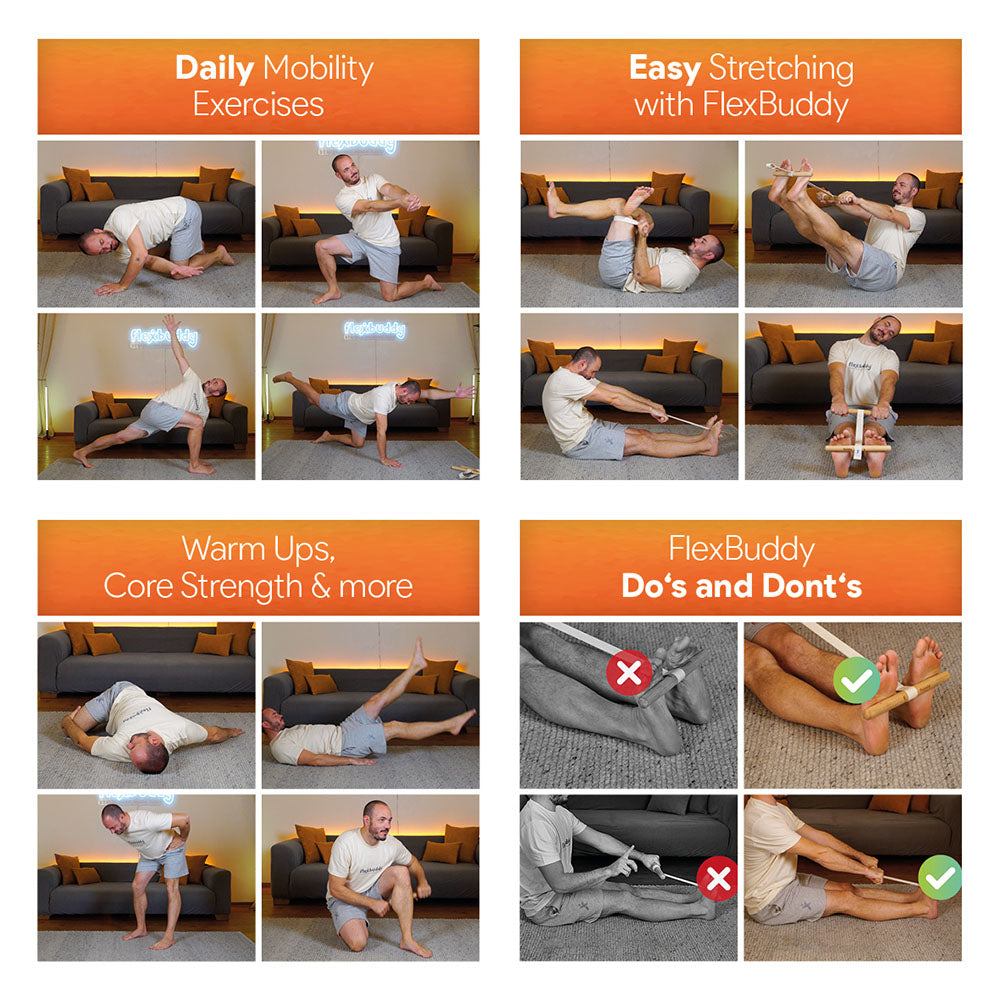
Four exercises from the Stretching Guide, in the order that suits stiff beginners: a moving warm-up, the posture that teaches the straight spine, a gentle spinal mobiliser, and the neck to finish. Shorten the strap to your current flexibility, not the one you would like to have.
| Exercise | Targets | Time | What you should feel |
|---|---|---|---|
| Hamstrings Warm Up | Hamstrings, lower back | 30 s | A light, moving pull along the back of the thighs |
| Basic Posture | Whole back, hamstrings, posture | 30 s | Decompression; the day's rounding reversing |
| Dynamic Rolling | Spine, segment by segment | 30 s | Gentle articulation along the spine |
| Relax The Neck | Neck, upper traps | 15 s per side | The upper traps letting go a notch |
1. Hamstrings Warm Up, 30 seconds
- Sit with legs extended, hook FlexBuddy around the soles of your feet, hold the handles.
- Sit tall and gently rock forward and back in a small, easy range.
- Breathe slowly and let the range grow on its own for 30 seconds.
What you should feel: a light, moving pull along the back of the thighs, a wake-up rather than a workout. Why it's first: rhythmic movement is the friendliest possible greeting for stiff tissue, and it sets up everything after it.
2. Basic Posture, 30 seconds
- Bend your knees slightly, keep FlexBuddy hooked, and let your arms straighten on the handles.
- Lean back a touch into the support, lift your chest, and let your spine lengthen.
- Breathe here for 30 seconds, shoulders soft.
What you should feel: decompression, the day's rounding gently reversing. Why it earns its slot: it gives your body a 30-second reminder of what tall feels like, which quietly supports better posture habits the rest of the day. Ten slow breaths is about 30 seconds and a better clock than counting.
3. Dynamic Rolling, 30 seconds
- From Basic Posture, keep light tension on the handles.
- Exhale and slowly round your spine backward, rolling down vertebra by vertebra; inhale and roll back up to tall.
- Repeat for 30 seconds, about three to four slow cycles. No momentum.
What you should feel: gentle articulation along the spine; a stuck back starting to feel oiled. Common mistake: rushing. One full breath per cycle is the speed limit.
4. Relax The Neck, 15 seconds per side
- Anchor FlexBuddy under your feet and hold one handle to gently weigh down that shoulder.
- Tilt your head slowly to the opposite side until a soft stretch appears along the neck.
- Hold 15 seconds, switch sides.
What you should feel: the upper traps, concrete by late afternoon, letting go a notch. Why it's the closer: ending at the neck means you stand up feeling lighter where you notice it most.
Two rules for all four. Stretch to mild tightness, never pain: a muscle that is being hurt contracts against you. And breathe through every hold; holding your breath is bracing. New to the device? How to use FlexBuddy covers the strap adjustment and the basic posture.
Morning, desk and before-bed versions
The morning version
Muscles are stiffest first thing, so give the warm-up more time and the holds less: Hamstrings Warm Up for 45 seconds, Basic Posture for 20, the rest as written. If the floor is the obstacle, sit up in bed with your legs straight; the strap works the same on a mattress. Our pieces on stretches you can do in bed and the morning stretching routine build the full wake-up sequence around it.
The desk or after-work version
By the end of a sitting day the hamstrings have been short for longest, so this is the default for most people. Do it the moment you get home, before the sofa: laptop closes, shoes off, two minutes. A two-minute break in work clothes is a change of posture, which is what the sitting research rewards. The longer routine for people who sit all day adds hips, shoulders and wrists for the days you have eight minutes.
The before-bed version
Evening is when most people are warmest, so this is where the holds can creep up: ten slow breaths in Basic Posture, Dynamic Rolling at half speed, the neck last, lights low. There is one piece of trial evidence for bedtime stretching if you are over 55: in a randomised trial of 80 adults with night-time leg cramps, six weeks of nightly calf and hamstring stretching just before sleep reduced cramps by 1.2 per night and made the rest less painful [11]. For everyone else, the honest statement is that the benefit is winding down, not a proven effect on sleep. One Amazon reviewer, Sara F.: "I use it before I go to bed and if I don't, I can really tell a difference in the morning."
How to progress after week 4
Do not add minutes faster than you add days. The first month is for the habit; the routine is already at a dose the evidence supports.
- Weeks 1 and 2: learn the positions. Same four exercises, same cue, every day. Shorten the strap only as far as a long spine allows. Measure something, such as fingertips to floor in a standing toe touch, and write it down.
- Week 3: one loop shorter. If the back stays long and the pull stays in the thighs, move the foot bar one loop shorter, or roll the strap a turn around the hand bar for a smaller step. If the lower back rounds, go back a step.
- Week 4: re-test. Repeat the measurement. Most people see a few centimetres.
- From week 5: more holds, not longer ones. Run the routine twice (four minutes, four muscle groups at the guideline dose), or swap Dynamic Rolling for the guide's static stretch: shorter loop, ten deep breaths, pause 30 seconds, three times. Holding much longer than 30 seconds has not been shown to add range [4][3], so more repetitions on more days is the better investment; see how long to hold a stretch.
- From week 8: widen the routine. Add hips, shoulders and calves from the full FlexBuddy exercise library, two or three at a time, still anchored to the same cue.
An honest timeline
Days: you feel it. The first sessions change how the back of your legs feels on standing up and how the neck feels at four in the afternoon. That is sensation, not yet range.
Weeks: you measure it. Programmes of three to eight weeks produce measurable range, attributed to stretch tolerance rather than longer muscle [7]; six weeks was enough in the hamstring trial [4]. Expect centimetres, not transformations. One honest three-star Amazon review said the device "does exactly what it should" but that at eight weeks he was still short of his toes, with progress; another owner reports bending 15 cm further after six months.
Months: the habit sets. Around two months on average, with wide variation [5][6], the two minutes stop being a decision. From then on the range stays as long as the habit does, and the habit costs two minutes.
Doing this with FlexBuddy
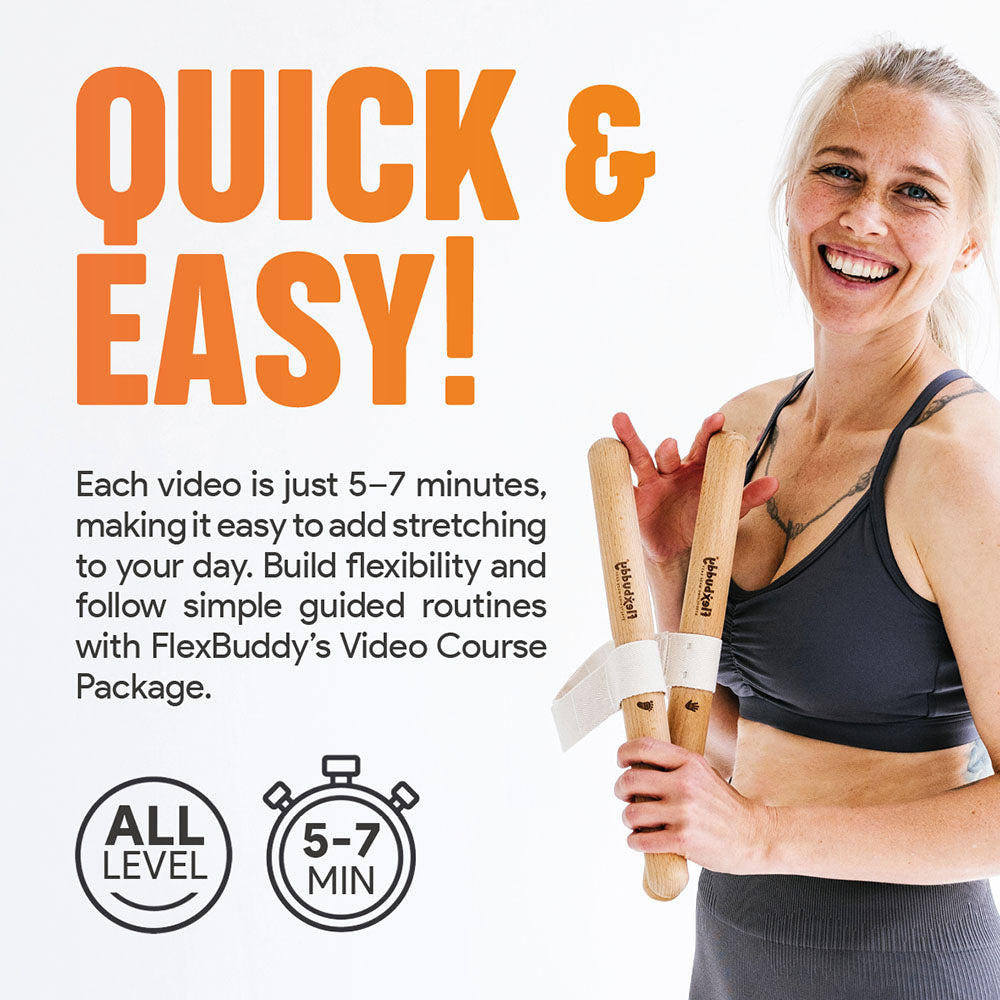
The routine is built on one position: a long spine folding at the hips, legs straight, held for 30 seconds. FlexBuddy® is a patented stretching device made of two beech-wood bars joined by an adjustable natural-cotton strap. One bar sits under the soles of your feet, the other in your hands; you sit tall, lean back and tilt the hips, and the strap carries the pull so the stretch lands in your hamstrings instead of your lower back. Two-way adjustment (move the foot bar between loops for big changes, roll the strap around the hand bar for small ones) lets a stiff beginner start long and shorten a notch a week. Wooden handles do not cut into your hands the way a strap or towel does, which matters when the routine has to feel good enough to repeat on day 40. It is about 32 cm long and lives next to the desk. "Sit at a desk 9 hours a day. My lower back used to ache every evening. Two weeks in, that's basically gone," wrote one owner. Lifetime warranty, 30-day money-back guarantee. See FlexBuddy, or take the two-minute quiz to get the routine for your kind of stiffness.
Frequently asked questions
Is 2 minutes of stretching enough?
For two muscle groups a day, yes. Guidelines ask for about 60 seconds per muscle group on at least two to three days a week [1][2]; four 30-second exercises deliver that daily, and 14 minutes a week clears the five-minute weekly threshold for range gains [3].
Should I stretch every day?
Daily is the easiest schedule to keep and sits within the evidence: a 2018 review suggested at least five days a week [3], and a 2024 meta-analysis found gains did not depend on high frequency, so a low daily dose is sensible [9]. Daily also forms the habit: the habit study used a once-a-day cue [5].
Is it better to stretch in the morning or at night?
Whenever it reliably happens. Harvard's summary of the ACSM guidance treats morning, after a workout and evening as equally valid [2], and the habit research says the consistent cue matters more than the hour [6]. Mornings are stiffer, so shorten the holds; evenings are more flexible, so they can grow.
Is stretching before bed good?
It is a calm way to finish the day, and for adults over 55 with night-time leg cramps a randomised trial found that nightly calf and hamstring stretching for six weeks reduced the cramps [11]. There is no strong evidence that stretching improves sleep itself in healthy adults, so treat it as a wind-down, and never stretch into pain late at night.
What is a good stretching routine for beginners?
Four exercises, 30 seconds each, once a day at the same cue: a moving hamstring warm-up, a straight-spine seated stretch, a gentle spinal roll and a neck release. Stop at mild tightness. Early gains come mainly from tolerating more stretch [7], so the goal is a calm position you can repeat, not depth. Over 50, holds towards 60 seconds may help [8].
Can I do a 2-minute stretch break at work?
Yes, and it counts twice: as stretching and as a change of posture after sitting. Do the four exercises on the floor with the strap, or, without equipment, a seated hip hinge with a long spine, a chair twist and a neck side-bend. Add a short walk.
This article is general information, not medical advice. Tight muscles usually respond well to regular stretching. If your pain is sharp, radiates down a leg, comes with numbness, weakness, fever, bladder or bowel changes, follows an injury, or keeps getting worse, see a doctor or physiotherapist before you stretch.
References
- Garber CE, Blissmer B, Deschenes MR, et al.; American College of Sports Medicine. Position stand: quantity and quality of exercise for developing and maintaining cardiorespiratory, musculoskeletal, and neuromotor fitness in apparently healthy adults. Med Sci Sports Exerc. 2011;43(7):1334–1359. doi:10.1249/MSS.0b013e318213fefb. PMID 21694556.
- Harvard Health Publishing. The ideal stretching routine. Harvard Medical School, 16 Mar 2026 (reviewed by H. E. LeWine, MD). https://www.health.harvard.edu/staying-healthy/the-ideal-stretching-routine (accessed 4 Nov 2026).
- Thomas E, Bianco A, Paoli A, Palma A. The relation between stretching typology and stretching duration: the effects on range of motion. Int J Sports Med. 2018;39(4):243–254. doi:10.1055/s-0044-101146. PMID 29506306.
- Bandy WD, Irion JM, Briggler M. The effect of time and frequency of static stretching on flexibility of the hamstring muscles. Phys Ther. 1997;77(10):1090–1096. doi:10.1093/ptj/77.10.1090. PMID 9327823.
- Lally P, van Jaarsveld CHM, Potts HWW, Wardle J. How are habits formed: modelling habit formation in the real world. Eur J Soc Psychol. 2010;40(6):998–1009. doi:10.1002/ejsp.674
- Gardner B, Lally P, Wardle J. Making health habitual: the psychology of 'habit-formation' and general practice. Br J Gen Pract. 2012;62(605):664–666. doi:10.3399/bjgp12X659466. PMC3505409. https://pmc.ncbi.nlm.nih.gov/articles/PMC3505409/ (accessed 4 Nov 2026).
- Weppler CH, Magnusson SP. Increasing muscle extensibility: a matter of increasing length or modifying sensation? Phys Ther. 2010;90(3):438–449. doi:10.2522/ptj.20090012. PMID 20075147.
- Page P. Current concepts in muscle stretching for exercise and rehabilitation. Int J Sports Phys Ther. 2012;7(1):109–119. PMC3273886. https://pmc.ncbi.nlm.nih.gov/articles/PMC3273886/ (accessed 4 Nov 2026).
- Konrad A, Alizadeh S, Daneshjoo A, et al. Chronic effects of stretching on range of motion with consideration of potential moderating variables: a systematic review with meta-analysis. J Sport Health Sci. 2024;13(2):186–194. doi:10.1016/j.jshs.2023.06.002. PMID 37301370; PMC10980866.
- Gollwitzer PM, Sheeran P. Implementation intentions and goal achievement: a meta-analysis of effects and processes. Adv Exp Soc Psychol. 2006;38:69–119. doi:10.1016/S0065-2601(06)38002-1
- Hallegraeff JM, van der Schans CP, de Ruiter R, de Greef MH. Stretching before sleep reduces the frequency and severity of nocturnal leg cramps in older adults: a randomised trial. J Physiother. 2012;58(1):17–22. doi:10.1016/S1836-9553(12)70068-1. PMID 22341378.